


MoU strengthens threat intelligence sharing, policy development and national capabilities to combat cybercrime
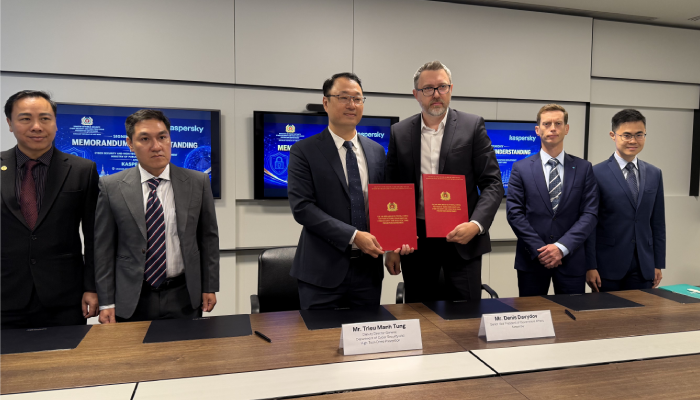
Kaspersky and Vietnam’s Cyber Security and High-Tech Crime Prevention Department under the Ministry of Public Security have signed a Memorandum of Understanding (MoU) aimed at strengthening the country’s cybersecurity capabilities amid accelerating digital transformation.
The agreement establishes a framework for cooperation in cybersecurity policy development, knowledge and technology exchange, international expertise sharing, and the exchange of threat intelligence and data on emerging cyberthreats.
The partnership comes as Vietnam’s expanding digital economy creates a broader attack surface for cybercriminals. For governments, this makes collaboration between public agencies and cybersecurity companies increasingly important—not only for responding to incidents, but also for developing proactive detection and prevention capabilities.
“In an increasingly complex cyberthreat landscape, multi-stakeholder cooperation is essential to strengthening resilience. This partnership will advance capacity building, knowledge exchange and Vietnam’s ability to address emerging cyber challenges.” — Denis Davydov, Senior Vice President, Government Relations, Kaspersky
Under the MoU, Kaspersky and the Department will work together to enhance capabilities in preventing, detecting and responding to cybercrime and high-tech crime. Training, expertise and technological solutions will form an important part of the cooperation.
The agreement builds on Kaspersky’s nearly two decades of engagement with government agencies, enterprises and research institutions in Vietnam. The company further strengthened its local presence in 2025 with the opening of an official office in Ho Chi Minh City.
The MoU was signed by Denis Davydov, Senior Vice President for Government Relations at Kaspersky, and Lieutenant Colonel Trieu Manh Tung, Deputy Director of the Cyber Security and High-Tech Crime Prevention Department.
The collaboration signals a broader shift toward public-private cybersecurity partnerships, where shared intelligence, skills development and coordinated response mechanisms become critical components of national cyber resilience.