



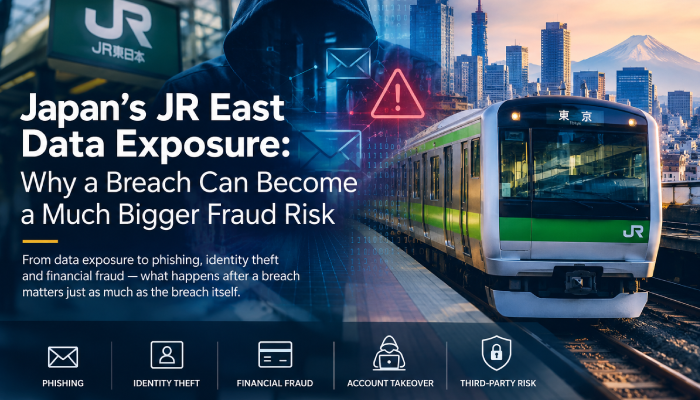
The potential exposure of millions of customer records highlights the growing intersection of data security, identity theft, phishing, financial fraud and third-party cyber risk. Global research shows why organisations must prepare for what happens after information is exposed—not just how to stop the initial breach.
The potential exposure of approximately 1.67 million customer email addresses linked to East Japan Railway Company (JR East) has brought renewed attention to a critical cybersecurity challenge: a data breach may be only the first stage of a much larger fraud risk.
The incident is significant not simply because of the number of potentially affected customers, but because of the opportunities that exposed information can create for cybercriminals. Email addresses connected to a recognised railway booking or membership service can help attackers craft convincing messages, impersonate legitimate organisations and persuade customers to disclose credentials, payment information or other personal details.
JR East’s October 9, 2026, notice said unauthorised access involving an external email-distribution service used by IDC Frontier had created the possibility that email-related log data had been viewed or acquired. The affected services included Ekinet, the railway booking platform, and Otona no Kyujitsu Club, a membership programme. JR East identified a maximum of approximately 1.67 million potentially affected Ekinet records and 390,000 Otona no Kyujitsu Club records. The latter category potentially included membership numbers, card expiry dates and dates of birth in addition to email addresses. The company said names, residential addresses, telephone numbers and full credit card numbers were not believed to have been exposed through this incident. JR East’s official notice.
The distinction between potential exposure and confirmed misuse is important. There is no basis to conclude from the disclosure alone that the affected information has been used for fraud. Nevertheless, the incident illustrates how a security weakness in one part of a technology ecosystem can create risks for customers who may have no direct relationship with the affected infrastructure provider.
“A data breach can become the starting point for a longer chain of cybercrime.”
Editorial analysis: the security challenge extends beyond containing the initial intrusion to preventing subsequent misuse of exposed information.
The economics of stolen information
The value of personal information to criminals lies in its potential to support several different forms of exploitation.
An email address can be used for targeted phishing, credential-stuffing attempts, account-recovery abuse or impersonation. When combined with other information, it can make fraudulent communications appear more credible. A message claiming that a railway booking requires verification, a membership is about to expire or a refund is pending may attract attention precisely because it resembles a routine customer-service interaction.
The risk increases when information from separate incidents can be combined. Criminals may acquire one dataset containing email addresses, another containing passwords or account identifiers, and additional information from public sources. Together, these fragments can make social-engineering attempts more convincing.
A report published by Verizon in 2025 analysed 22,052 security incidents, including 12,195 confirmed breaches. Its findings continued to identify credential abuse, social engineering and exploitation of vulnerabilities among the important routes through which attackers gain access to organisations. The research reinforces the need to treat data exposure as part of a broader attack chain rather than an isolated privacy event. Verizon 2025 Data Breach Investigations Report.
The implications extend beyond the original organisation. A customer deceived by a fraudulent message may lose access to an account, reveal banking credentials or authorise a transaction. The financial institution that processes the resulting fraud may have had no involvement in the initial breach, yet it may still face investigation costs, reimbursement disputes and customer complaints.
What cybersecurity experts are warning about
The concern over the misuse of exposed personal information is not limited to the JR East case. Japanese broadcaster KAB reported on October 9 that cybersecurity specialist Takayuki Domae, an executive in the technical division at Internet Initiative Japan (IIJ), had warned about the growing number of incidents involving the potential removal of large volumes of personal information.
“The cybersecurity industry is feeling a strong sense of urgency.”
— Takayuki Domae, technical division executive, Internet Initiative Japan (IIJ). Translated from remarks reported by KAB.
Domae also described how stolen personal information can be sold through underground markets or used in extortion. His comments point to a central problem for incident response: the organisation that discovers an exposure may not know whether the data has been copied, who may possess it or how it could be used in the future.
This uncertainty makes containment, forensic investigation and customer communication especially important. It also means that organisations should avoid making unsupported assurances that exposed data has no value simply because it does not include full payment-card numbers or passwords.
The appropriate response is risk-based. The types of information involved, the way it was stored, the evidence available about access and the possibility of combining it with other datasets should determine the level of customer warning and protective action.
AI is changing the economics of cybercrime
Artificial intelligence adds another dimension to the problem. Attackers can use generative AI to produce fluent, personalised messages at scale, adapt communications to different languages and automate parts of reconnaissance and social engineering. AI does not make every breach more dangerous by itself, but it can make some forms of exploitation faster and easier to scale.
IBM’s 2026 Cost of a Data Breach research, based on incidents at 602 organisations between March 2025 and February 2026, found that one in four malicious breaches in its study was AI-enabled, an increase of 56% from the previous year. These incidents cost an average of US$6 million, compared with a global average breach cost of US$4.99 million. IBM identified deepfake impersonation and AI-enabled malware among the major contributors. These are broad findings from IBM’s global research, not figures specific to the JR East incident. IBM 2026 Cost of a Data Breach Report.
“AI is making attacks faster and cheaper, while breaches keep getting more expensive.”
— Suja Viswesan, Vice President, IBM Security Software. IBM Newsroom.
Viswesan’s assessment highlights the widening gap between the speed at which attacks can be launched and the time organisations may need to investigate and contain them. For customers, the concern is that convincing fraudulent messages can arrive quickly, while an organisation may still be establishing precisely what information was exposed.
The answer is not to assume that AI will inevitably turn every breach into a fraud wave. Rather, organisations need controls that reduce opportunities for misuse, alongside monitoring and response mechanisms capable of adapting to increasingly automated attacks.
Third-party security is now a customer protection issue
The JR East disclosure also demonstrates why third-party risk deserves attention at board level.
Modern organisations rely on external providers for cloud infrastructure, customer communications, identity services, payment processing and other essential functions. Outsourcing can improve efficiency and scalability, but it also creates dependencies that must be assessed and monitored.
The US Federal Trade Commission’s guidance for businesses responding to data breaches explicitly recommends reviewing service providers’ access to personal information, verifying that vulnerabilities have been corrected and determining whether access privileges should be changed. It also stresses the importance of forensic investigation, preserving evidence and communicating clearly with affected customers. FTC Data Breach Response Guide.
For technology leaders, this means going beyond checking whether a supplier has a security certification. Organisations should understand which data a provider can access, how access is restricted, what monitoring is in place and how quickly the provider can support an investigation.
Contracts should establish incident-notification expectations, responsibilities for forensic evidence, escalation procedures and cooperation during recovery. Equally important, companies need to know whether the compromise of one service can expose data held by other systems.
A supplier incident should trigger a review of the wider environment, not simply a request for the provider to confirm that the immediate vulnerability has been fixed.
Banks and payment providers must prepare for downstream fraud
Financial services organisations may be affected by data breaches that occur elsewhere. A criminal who obtains a customer’s email address and other personal details may use them to create a plausible impersonation attempt against that individual’s bank or payment provider.
The response should combine strong authentication with transaction monitoring, suspicious-session detection and risk-based verification for sensitive actions. Phishing-resistant authentication methods, including passkeys and hardware security keys, can reduce the risk of credential theft, although they cannot eliminate every form of social engineering.
Banks should also make it straightforward for customers to report suspicious messages and verify whether a communication is genuine. Where a breach is linked to an emerging phishing campaign, affected companies, financial institutions, email providers and law enforcement can coordinate relevant warnings and indicators.
Such cooperation needs to be proportionate and privacy-preserving. The objective is to reduce fraud, not to collect more customer information than necessary.
Consumers need practical warnings, not general reassurance
Consumers cannot determine from a public breach notice whether their individual information has been accessed or misused. Organisations must therefore provide clear, specific guidance based on the information potentially exposed.
For affected customers, the immediate priority is to treat unexpected messages about bookings, membership renewals, refunds or account verification with caution. Customers should visit the official website or application directly rather than follow links in unsolicited messages, and should never disclose passwords or one-time authentication codes in response to an unexpected request.
Using unique passwords and enabling multi-factor authentication can help protect accounts, particularly where the same email address is used across multiple services. Customers should also monitor relevant accounts for unusual activity and report suspicious communications through official channels.
The FTC similarly advises businesses to tell affected individuals what information may have been exposed and what steps they can take to protect themselves. It cautions against misleading statements and recommends making relevant guidance easy to find. The principle is straightforward: transparency should help people act, not merely reassure them.
From breach containment to fraud prevention
The JR East case reinforces a broader shift in cybersecurity priorities. Organisations must still prevent intrusions, secure infrastructure and investigate unauthorised access. But they must also consider what happens after information leaves their control.
That requires connecting breach response with identity security, phishing detection, third-party governance, financial fraud monitoring and customer communication. Security teams should plan for the possibility that exposed data could be misused later, even when there is no immediate evidence of fraud.
For boards and business leaders, the measure of resilience should not be limited to whether an attack was stopped. It should also include how quickly the organisation identified the scope of exposure, restricted further access, informed customers and coordinated with partners to limit downstream harm.
The message for consumers is equally important: potential exposure does not automatically mean identity theft or financial loss, but it can give criminals material for more credible deception.
In an interconnected digital economy, the real test of cyber resilience is whether organisations can stop an initial compromise from becoming a prolonged crisis of fraud, customer confidence and trust.