



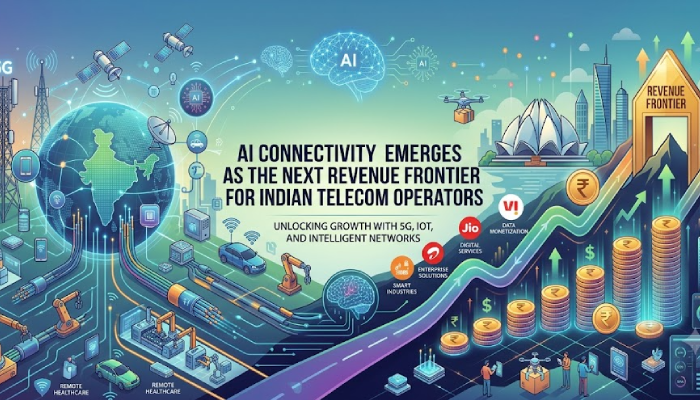
Ciena Research Reveals Strong Confidence in AI-Driven Services, Optical Network Upgrades, and Edge Computing Opportunities
India’s telecommunications sector is entering a new growth phase as service providers increasingly view artificial intelligence (AI) as a major catalyst for future revenue generation. A recent survey commissioned by Ciena reveals that telecom operators across the country are rapidly shifting their focus from network expansion to AI infrastructure, advanced connectivity services, and intelligent digital ecosystems.
The research, conducted by Censuswide among telecom operators, wholesale fiber network providers, and regional service providers across 12 global markets, found that Indian respondents are among the most optimistic about AI’s business potential. According to the study, 67% of Indian service providers strongly agree that AI-driven network services will be a primary driver of revenue growth over the next three to five years, while another 27% somewhat agree.
The findings underscore how telecom companies are redefining their role in the digital economy. Rather than serving solely as connectivity providers, they are increasingly positioning themselves as enablers of AI-powered enterprise transformation.
AI Driving a New Telecom Business Model
The rapid adoption of generative AI, machine learning, automation, and intelligent analytics is dramatically increasing the demand for high-capacity, low-latency connectivity. Enterprises deploying AI applications require networks capable of moving massive datasets between data centers, cloud environments, edge locations, and end-users with minimal delay.
As a result, service providers see significant opportunities in delivering specialized AI connectivity services that go beyond traditional bandwidth offerings.
The survey indicates widespread confidence that AI-related services will unlock new revenue streams, particularly in areas such as cloud connectivity, edge computing, managed optical networks, and physical AI applications. These services are expected to support enterprise workloads that require high-performance network infrastructure and guaranteed service levels.
“After going through one of the fastest 5G rollouts globally, Indian service providers are now shifting focus to AI infrastructure builds and AI monetization. AI momentum continues to escalate, and the survey findings point to growing confidence in the revenue potential of AI-driven services,” said Gautam Billa, Vice President, Solutions Engineering and Chief Technology Officer, Asia Pacific, India and Japan, Ciena.
Data Center Connectivity Gains Strategic Importance
One of the strongest opportunities identified by respondents is interconnecting distributed AI compute environments.
AI workloads increasingly depend on geographically dispersed data centers, GPU clusters, and cloud infrastructure. To support this shift, telecom providers are investing in managed optical fiber network (MOFN) services capable of transporting enormous volumes of data efficiently and securely.
According to the survey, 98% of Indian respondents expect MOFN services to contribute to revenue from connecting distributed AI compute clusters within the next three years. Nearly half, 48%, believe these services will become a significant source of revenue growth.
The results highlight the growing strategic role of telecom operators in supporting the infrastructure backbone required for large-scale AI deployments.
Optical Network Modernization Becomes Urgent
While AI presents enormous growth opportunities, respondents acknowledge that existing network infrastructure must evolve to meet future requirements.
The survey reveals overwhelming support for optical network modernization:
- 93% of respondents believe next-generation optical technologies are essential for making AI connectivity services more profitable and competitive.
- 88% say optical network upgrades are urgently needed to deliver the low-latency and high-reliability performance required by enterprise AI applications.
- 38% believe major upgrades should happen immediately.
Emerging technologies such as higher-capacity wavelengths and energy-efficient coherent optics are expected to become critical building blocks for supporting AI-powered workloads. These technologies will enable service providers to deliver faster, more scalable, and cost-effective connectivity solutions while maintaining operational efficiency.
Automation Key to Managing AI-Era Networks
Modern AI environments generate highly dynamic traffic patterns that can fluctuate rapidly based on computational demands and user activity. Managing these environments manually is becoming increasingly difficult.
Recognizing this challenge, 94% of surveyed Indian service providers consider advanced network automation either important or absolutely critical for capturing AI-driven business opportunities.
Automated networks can intelligently allocate resources, optimize traffic flows, and respond to changing workloads in real time. For telecom operators, this not only improves customer experience but also reduces operational complexity and enhances network efficiency.
As AI traffic volumes continue to surge, automation is expected to become a foundational capability for future telecom infrastructure.
Edge Computing Creates Premium Service Opportunities
Another major finding from the survey is the growing importance of edge computing in enterprise AI deployments.
By processing data closer to users and devices, edge computing reduces latency and improves application responsiveness. This capability is particularly important for AI workloads that require near-instant decision-making.
The study found that 96% of respondents believe guaranteed low-latency performance is very important or absolutely critical for generating revenue from enterprise edge deployments.
Additionally, 37% identified stable performance and minimal network jitter as the premium service category with the highest revenue potential.
This suggests enterprises are increasingly willing to pay for differentiated connectivity services that guarantee performance rather than simply offering greater network capacity.
Physical AI Opens New Growth Markets
The rise of Physical AI is creating yet another opportunity for service providers.
Physical AI encompasses technologies such as autonomous robots, machine vision systems, industrial automation platforms, and remotely operated machinery. These applications depend heavily on reliable communications networks and edge computing capabilities.
According to the research, 93% of Indian respondents see moderate to high revenue potential from Physical AI-related private network and edge computing services.
Even more notably, 59% expect Physical AI to contribute more than 15% of total AI-related enterprise revenue within five years.
As industries including manufacturing, logistics, healthcare, and smart infrastructure accelerate automation initiatives, telecom operators are positioning themselves as essential partners in supporting these intelligent ecosystems.
Multi-Cloud Connectivity Fuels New Revenue Models
Enterprise AI workloads frequently span multiple cloud environments, creating a growing need for seamless and secure multi-cloud connectivity.
Indian service providers are adapting by exploring more flexible commercial and service delivery models. The survey found that:
- 58% plan to generate revenue through multi-cloud connectivity management services.
- 58% expect growth from consumption-based bandwidth offerings.
These findings indicate a broader industry movement toward service-based and outcome-focused revenue models. Rather than selling fixed connectivity packages, providers are increasingly offering flexible solutions aligned with enterprise consumption patterns and AI workload requirements.
AI Infrastructure Services Expected to Drive Enterprise Growth
Beyond networking, service providers also expect strong demand for AI infrastructure services delivered closer to end users.
Services such as GPU-as-a-Service, localized AI inference, edge computing, and private wireless networks are emerging as significant business opportunities.
According to the survey, 88% of Indian respondents expect these services to contribute at least 10% of total enterprise revenue within the next three years, while 35% believe they could generate more than 20% of enterprise revenue.
These projections highlight how telecom companies are evolving into providers of integrated digital infrastructure capable of supporting AI innovation across industries.
A Defining Moment for India’s Telecom Industry
India’s telecommunications sector has already demonstrated its ability to execute at scale through the rapid deployment of 5G networks. The next chapter appears to be centered on AI-driven transformation.
The Ciena research suggests that service providers recognize both the opportunities and the infrastructure requirements associated with this transition. Investments in optical networking, automation, edge computing, managed fiber services, and cloud connectivity are increasingly being viewed as essential to unlocking future growth.
As enterprises intensify their AI adoption strategies, telecom operators that modernize their networks and build AI-ready service portfolios will be best positioned to capture new revenue streams and strengthen their role in India’s digital economy.
The survey’s findings make one thing clear: for Indian service providers, AI is no longer just a technology trend. It is emerging as a fundamental business opportunity capable of reshaping network strategies, investment priorities, and revenue models for years to come.