




Author : Dr Subroto Kumar Panda, CIO, Anand and Anand
The digital ecosystem is undergoing an architectural segment change. For more than two decades, the internet operated primarily as a presentation layer engineered for human consumption, with software serving as a deterministic tool to fulfil explicit user intents. Today, that paradigm is structurally obsolete. We have entered the era of the Agentic Web—a network architecture defined by autonomous machine-to-machine (M2M) interaction, deep reasoning engines, and self-healing systems.
Driven by advancements in large language models (LLMs) and open interface standards like the Model Context Protocol (MCP), the boundary between passive script execution (“bots”) and cognitive, multi-system task execution (“agents”) has dissolved. For enterprise technology leaders, this transition requires a complete reassessment of network capacity, system architecture, and human labour allocation.
1. The Taxonomical and Architectural Frontier: Deconstructing Bots vs. Agents
To govern this new environment effectively, technologists must use precise terms to distinguish between these automated entities. The shift from deterministic code to autonomous agency occurs across three distinct structural tiers.
Traditional Bots
Traditional bots are deterministic, rule-based software scripts designed to execute repetitive, single-turn tasks. Operating via static conditional logic (IF/THEN), their structural integrity is highly brittle; any minor mutation to an underlying user interface or data schema causes runtime failure.
Generative Chatbots
These systems leverage foundational LLMs to provide probabilistic, conversational interfaces. While highly capable of pattern matching and human-like text generation, their operational window is inherently bounded by a stateless architecture. They excel at information synthesis within an active session but lack the native capacity to alter external systems.
Autonomous AI Agents
An agent is an integrated cognitive system. It pairs an LLM reasoning core with explicit execution modules: short-term task memory, long-term historical vector databases, dynamic planning algorithms, and tool-use capabilities (APIs). Agents evaluate open-ended objectives, decompose them into an ordering of execution steps, interpret environmental feedback, and adapt their workflows at runtime.
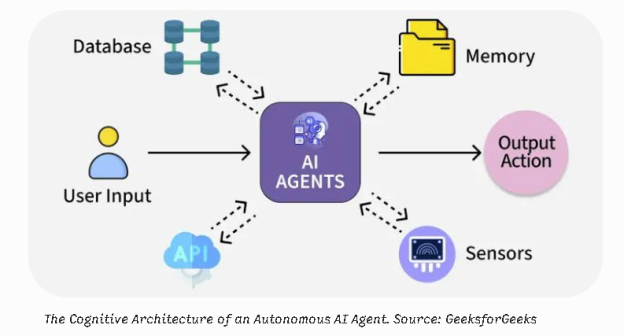
The architectural decoupling shown above highlights how an agent interacts dynamically with its environment via continuous feedback loops, distinguishing it from static, isolated automated scripts.
2. Network Asymmetry: The Macro Metrics of Machine Traffic
The transition to agentic infrastructure is visible across global enterprise metrics and network telemetry.
The C-Suite Pivot to Production
Enterprise implementation has advanced past the phase of speculative proofs-of-concept. Data reveals that 91% of global enterprises have integrated AI into at least one operational function, while 62% are actively deploying or scaling autonomous AI agents.
According to market research by Gartner, 40% of all enterprise software applications will feature embedded, task-specific AI agents. This deployment is highly concentrated in information-dense, high-throughput environments:
| Industry Sector | Agentic AI Adoption Rate | Primary Operational Use Case |
| Technology & Software | 31% | Automated Code Refactoring & CI/CD Validation |
| Financial Services | 29% | Autonomous Fraud Triage & Portfolio Compliance Auditing |
| Insurance | 28% | End-to-End Claims Processing & Risk Re-underwriting |
| Healthcare | 27% | Clinical Documentation Synthesis & Diagnostic Verification |
The Crossover to Machine-Majority Traffic
The physical pipelines of global network infrastructure reflect this machine-driven surge. Network telemetry indicates that automated traffic now constitutes 53% of all global web traffic, rendering human activity a 47% minority stakeholder on the open web.
Data from the 2026 Imperva Bad Bot Report shows that malicious automated systems (bad bots) account for 40% of this footprint, driven by highly distributed account takeover (ATO) operations and automated scraping. Concurrently, data traffic from legitimate conversational AI agents and LLM indexers grew by nearly 8,000% year-over-year.
Crucially, this automated traffic increasingly avoids the traditional browser entirely: 27% of all machine-driven interactions now target APIs directly, executing operations at machine speed without rendering the presentation layers designed for human eyes.
3. Algorithmic Self-Rectification in Software Engineering
In the engineering lifecycle, autonomous agents have evolved past writing basic boilerplate scripts. They now operate as autonomous debuggers within advanced software development life cycles (SDLC).
When a software engineer assigns a complex deployment task to an agentic network, the output is not immediately committed to production repositories. Instead, it enters a multi-agent validation loop designed to eliminate execution failure before human review.

This automated loop shifts human engineering labour from tedious debugging to systemic code curation, reducing standard development lifecycle friction significantly.
4. Autonomic Infrastructure: Constructing Self-Healing Runtime Environments
Beyond the compilation phase, autonomous agents are transforming Site Reliability Engineering (SRE) by creating self-healing applications capable of dynamic, runtime remediation.Traditional infrastructure monitoring relies on static thresholds (e.g., alerting when CPU utilization exceeds 90%). These setups are inherently reactive, requiring an on-call engineer to log in, analyze logs, and manually restart services. In contrast, an agentic self-healing architecture treats infrastructure monitoring as a continuous closed-loop control system.
The Mechanics of an Autonomous Remediation Loop
- Continuous Observability: An Observability Agent continuously ingests unstructured application logs, distributed traces, and container performance metrics. Instead of relying on static rules, it maps real-time trends against historical behavioural baselines.
- Contextual Diagnosis: If a microservice encounters a critical degradation—such as an unhandled database connection pool exhaustion—the agent detects the anomaly. It immediately queries system state machines and historical logs using internal vector-space retrieval to isolate the source of the failure.
- Orchestration and Tool Use: Once the failure mode is isolated, the agent uses open interface standards like the Model Context Protocol (MCP) to securely communicate across the application infrastructure layer.
- Remediation Execution: The agent can autonomously provision a parallel, isolated container pod, execute an automated rollback to the last stable deployment tag, modify ingress configuration rules to handle unexpected traffic surges, and safely terminate the degraded container.
Systemic Isolation: By segregating the degraded asset and instantiating a clean rollback version at runtime, the agent maintains maximum system availability, reducing mean time to resolution (MTTR) from hours to milliseconds without human intervention.
5. Strategic Imperatives for the Autonomous Enterprise
The rise of the Agentic Web forces technology leaders to rethink system architecture and data governance. To leverage this automation while mitigating its structural risks, organizations must implement three foundational disciplines:
- Robust API-First Infrastructure: Because agents consume data programmatically and bypass conventional user interfaces, enterprise data layers must be exposed via clean, secure, machine-readable APIs.
- Comprehensive Zero-Trust Governance: Giving agents system privileges introduces risk. Security architectures must implement granular, tool-by-tool identity management, ensuring that every automated read, write, and payment action is bounded by strict security permissions.
- Verifiable Audit Records: To combat execution errors and prompt injection vulnerabilities, organizations must implement isolated, read-only logging layers that record every decision, tool call, and reasoning step taken by an active agent.
The technological landscape is no longer defined by how humans interact with software, but by how effectively organizations orchestrate machine-to-machine coordination. The competitive advantage belongs to enterprises that build the most resilient, secure, and self-healing agentic networks.