

Beyond tariffs and trade, the landmark India–EU FTA is emerging as a strategic pact on data flows, digital infrastructure, and trust one that could redefine India’s technology diplomacy
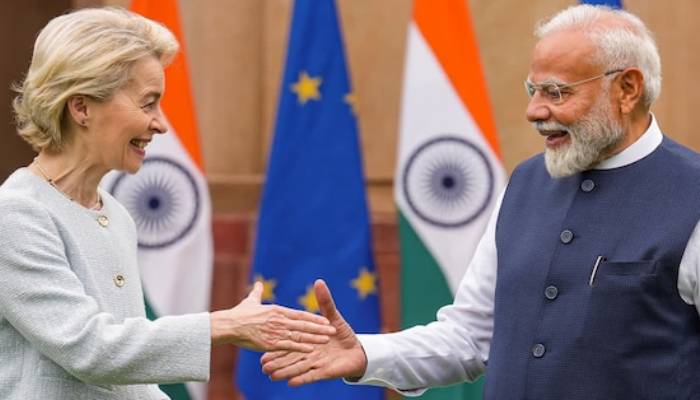
As India and the European Union prepare to sign a long-awaited Free Trade Agreement (FTA), the deal is increasingly being viewed not merely as a trade pact, but as a strategic blueprint for the future of the digital economy. Expected to be formalised during the visit of European Commission President Ursula von der Leyen to India as the chief guest for Republic Day 2026, the agreement could influence how India balances data sovereignty, cross-border data flows, and global technology partnerships.
Speaking at the World Economic Forum in Davos on January 20, 2026, von der Leyen described the proposed agreement as “a historic trade agreement… one that would create a market of two billion people, accounting for almost a quarter of global GDP.” India’s Commerce Minister Piyush Goyal has gone a step further, calling the EU–India FTA the “mother of all deals” when compared to India’s recent trade agreements with developed economies.
While negotiations began as early as 2007, the talks remained stalled for years due to differences over regulatory frameworks, tariffs, and market access. Momentum returned in July 2022, and by July 2025, negotiators confirmed that the digital trade chapter had been agreed in principle a critical breakthrough in an increasingly data-driven global economy.
“Digital trade today sits at the intersection of economic growth and strategic autonomy,” says Dr. Aakansha Natani, Assistant Professor at the Human Sciences Research Centre, IIIT Hyderabad. “How India negotiates cross-border data flows in this agreement will shape not just trade outcomes, but its future digital diplomacy.”
At the heart of the digital trade chapter lies the sensitive issue of cross-border data flows. The European Union has consistently pushed for provisions that allow data to move freely to support digital services and innovation, while discouraging strict data localisation mandates. India’s position, however, has evolved over time, reflecting tensions between economic integration and concerns around national security, legal jurisdiction, and digital sovereignty.
“The default setting for data is to flow,” Natani explains. “But once domestic regulations restrict that flow, interoperability across technical, legal, and policy standards becomes the gatekeeper of participation in the global digital economy.”
These questions take on added urgency in the age of Artificial Intelligence, where data functions both as raw material and as the fuel powering AI systems. Regulatory standards, therefore, increasingly determine who can innovate, scale, and compete globally.
India’s domestic policy trajectory mirrors this complexity. Early drafts of the Digital Personal Data Protection (DPDP) framework mandated strict localisation of critical data. Subsequent versions gradually relaxed these requirements, and the DPDP Act passed in 2025 adopted a more flexible approach allowing cross-border transfers except to specifically restricted jurisdictions. Yet, regulators such as the Reserve Bank of India continue to mandate full localisation for sensitive sectors like payments.
Against this backdrop, industry leaders see the FTA as a signal of confidence and long-term alignment. Sunil Bharti Mittal, Founder and Chairman of Bharti Enterprises, said the agreement reflects “the decisive leadership and strategic resolve of Prime Minister Shri Narendra Modi and the European political leadership in strengthening the India–EU partnership.”
“In a changing global economic order, the agreement sends a powerful signal of trust, stability, and long-term partnership,” Mittal noted.
From a technology and infrastructure perspective, Mittal believes the FTA could unlock significant opportunities on both sides. “This agreement will open new avenues for collaboration, particularly in digital infrastructure, space connectivity, and secure networks,” he said, adding that it offers “European investors a compelling opportunity to innovate and scale with India for global markets.”
Importantly, the pact also enables two-way digital investment. “It opens opportunities for Indian companies like Airtel to invest in the digital infrastructure in Europe,” Mittal added underscoring the growing global ambitions of Indian technology and telecom firms.
The EU’s own approach to data transfers remains firmly anchored in the General Data Protection Regulation (GDPR), which permits data flows only to countries offering an “essentially equivalent” level of protection. India has yet to receive an EU adequacy decision, making the safeguards and commitments embedded in the FTA’s digital trade chapter especially consequential.
“The EU is a norms-heavy partner,” Natani observes. “Its emphasis on rules, standards, and regulatory alignment means this agreement could set the template for India’s future digital trade negotiations including with the United States.”
With India also in talks with Washington where data localisation has already been flagged as a non-tariff barrier the EU–India FTA may become the benchmark that shapes India’s bilateral and multilateral engagements on data.
In that sense, the agreement goes well beyond trade volumes or tariff reductions. It represents a strategic choice about how India positions itself in a fragmented digital world balancing openness with sovereignty, and scale with trust.
As Mittal summed it up, “This is a turning point in our shared future.”