

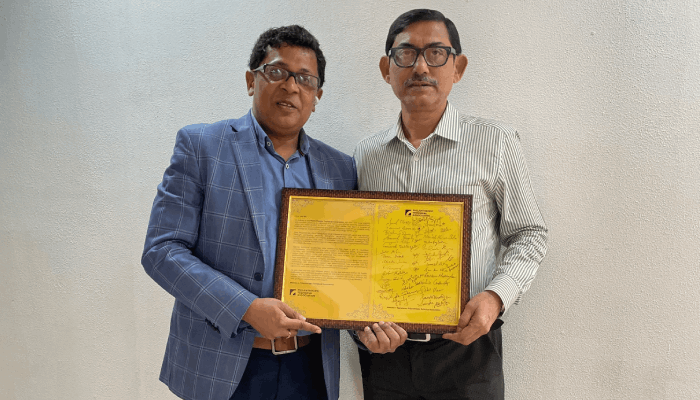
On 5th December 2025, during a heartfelt felicitation organized by the Philanthropic Technical Association, Joy Bagish, General Manager – Information Technology at Apeejay Surrendra Management Services Pvt. Ltd., marked the culmination of an illustrious career spanning 25 years. As he steps into retirement, Joy reflects on a remarkable journey that witnessed transformative technology adoptions, strategic innovations, and a relentless pursuit of excellence. His insights offer a rare perspective on how IT evolved from foundational systems to cutting-edge digital platforms, shaping the future of enterprise solutions.
Looking back at your career, what has been the most defining moment in your journey as a CIO?
The defining moment of my CIO journey was to transform our Group from scattered IT systems into a unified, cyber-resilient setup across offices and vessels. We developed a secure and scalable digital backbone that powers reliability and growth by putting in place centralized governance, upgrading marine communications, and adding advanced cybersecurity and continuity systems.
What were the biggest digital transformation milestones you achieved at Apeejay Surrendra Group?
Some of the proud moments were about bringing all business units under one set of IT rules and security standards, overhauling our network and data centers, and making sure backup and disaster recovery were rock solid everywhere. I helped get our ships fully connected with modern satellite systems and automated a lot of our daily work with new monitoring tools and clear service agreements. Moving to cloud-ready platforms meant we could scale up and adapt fast. All these steps turned our old, scattered systems into a single, secure, flexible digital environment ready for whatever comes next.
“Technology is not just about systems—it’s about enabling people to dream bigger and achieve more. My journey has been about turning possibilities into realities.” — Joy Bagish
Over the years, how did you balance modernization with legacy systems that were critical to business continuity?
It secured core legacy through a dual-track plan while deploying modern, scalable technology across the Group. The old systems remained stable with tight rules and standard setups along with strong backups and continuity measures, while new cloud work was launched along with Unified Networks, Modern Security, vessel upgrades, and central monitoring- never stopping the business. Using APIs, virtualization, and step-bystep migrations, this kept operations running smoothly and shifted to a secure, futureready IT setup.
Cybersecurity has become a boardroom priority. How did your approach to cyber resilience evolve during your tenure?
The Group’s cyber-resilience shifted from basic perimeter defenses to a full, multi-layer security system, greatly improving protection for both IT and operational environments. We replaced old antivirus and firewalls with SIEM threat detection, EDR/XDR tools, and central identity controls, plus secure tunnels, standard firewalls, vulnerability fixes, identity checks and ongoing log checks for vessels and remote sites. Now cybersecurity is built into IT rules, vendor contracts, backups, and budgets—as a proactive, boardbacked risk function, not just tech fixes
What leadership principles guided you when building and mentoring high-performance IT teams?
I built IT leadership on four simple principles: clarity, accountability, empowerment, and continuous learning. The teams received clear KPIs, processes, and governance so that everyone knew their role for keeping the systems running, secure, and reliable across networks, cybersecurity, vessels, and support. I gave them ownership with training, tools, data tracking, SLA goals, and open communication that turned this team from basic support into key partners in reliability, security, and digital growth.
What was the toughest crisis or technology disruption you navigated, and what did it teach you?
The toughest problem I handled was a big network and security issue that hit company offices and ship communications at the same time. Satellite links were failing, and key services, including ERP connectivity, were in danger, so I started our backup plan, moving important work to spare paths, using fast isolation to stop threats and fixing ship-to-office data with safe temp links. We also used the latest antivirus tools with EDR/XDR capability threat detection, behavior checks, identity management, and autolockdown to block malware and spot advanced risks fast. This again proves that real strength comes early through clear rules, standard setups, live monitoring, and a trained team-not from quick fixes that save business.
How did you ensure IT remained aligned with business goals in a rapidly changing market environment?
In doing so, I integrated IT into business planning by anchoring each technology project to explicit operational, financial, or compliance objectives. With centralized governance, consistent KPIs, SLA-managed third-party vendors, and continuous dialogue with business heads from vessels and corporate to schools and retail, IT priorities always matched real needs. Regular reviews, return on investment checks, and a versatile digital roadmap enabled us to move nimbly with the market, positioning IT as a strategic driver of efficiency, security, and growth across the Group.
What technologies or innovations made the greatest impact during your tenure—and which ones disappointed?
The most impactful technologies boosted reliability and security: modernized networks, hybrid cloud platforms, SIEM + EDR/XDR cybersecurity, centralized backups/replication, and standardized vessel systems. Such directly lifted uptime, data integrity, and visibility across all business units. Legacy OEM solutions and scattered point-tools that promised integration but built silos, lacked scalability, and struggled with marine connectivity disappointed. The key lesson learnt here is that real impact flows from scalable and governance-aligned tech, not from isolated tools or vendor hype.
As you step away from the CIO chair, what advice would you give to your successor and to young aspiring technology leaders?
To my successor: Prioritize governance, resilience, and business alignment-tech is merely a means to an end. Build a skilled accountable IT team and embed cybersecurity, BCP, and vendor management into every decision.
To Young Tech Leaders, focus on lifelong learning, adaptability, and solving problems amid uncertainty. Master both legacy and new tech, grasp business needs behind IT choices, and lead by empowering others to deliver secure, reliable solutions with real impact.
If you could rewind your career, is there anything you would do differently in terms of decisions, risks, or learning?
If I could do it all over again, I would have adopted strategic initiatives and new technologies much sooner. Of course, thirty years ago, IT was about infrastructure and support, but early movers in enterprise integration, networking, and automation could have accelerated outcomes. I would have also focused on cross-team collaboration and mentorship much earlier, as it is in the linkage of IT and business that true transformation resides. In reflection, I am proud of my journey. The amalgamation of the foundation with contemporary IT leadership, digital transformation, data strategy, and innovation continues to be a high-impact combination that assures success for both organization and team.