


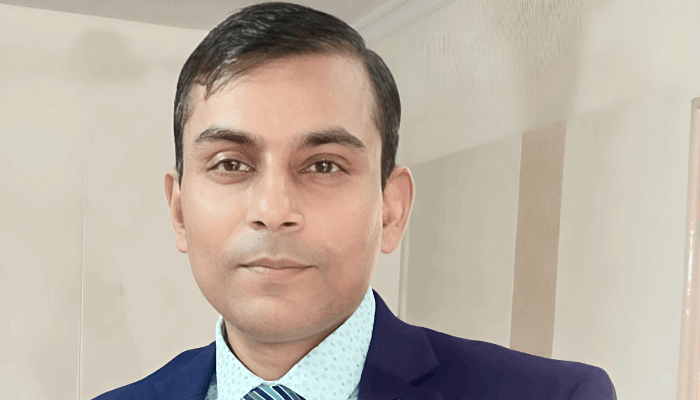
After two decades of building mission-critical systems in the Indian Navy, Anubhav Agrawal now leads Fidelity Brokerage India’s security engineering initiatives — championing a vision where security is not a defensive barrier, but a strategic enabler of innovation, personalization, and digital confidence.
In an industry where the convergence of trust, technology, and security defines business success, leaders like Anubhav Agrawal, Vice President – Fidelity Brokerage India, are demonstrating what it means to transform security from a technical necessity into a strategic enabler. His journey from serving in the Indian Navy to becoming a security engineering leader at Fidelity Brokerage India is a testament to purpose-driven leadership.
With nearly two decades in the Indian Navy, Agrawal was deeply involved in designing secure communication systems, embedded frameworks, cryptographic architectures, and mission-critical operational technologies. “That experience instilled in me a mission-first mindset and a deep respect for the role of technology in safeguarding trust and integrity,” he reflects.
“Security is no longer just a technology function — it’s a trust architecture.”
– Anubhav Agrawal, VP, Fidelity Brokerage India
Today, as VP at Fidelity Brokerage India, he leads engineering teams that build secure digital capabilities, personalized login experiences, and resilient cybersecurity systems. His philosophy is clear — security isn’t merely a shield; it’s a foundation for user trust, responsible innovation, and seamless digital experiences.
The Architecture of Secure Systems: Principles Over Products
Agrawal defines secure systems engineering as “both an art and discipline.” His approach is grounded in six key design pillars: security by design, defense in depth, zero-trust principles, observability and resilience, user-centric security, and continuous validation. These are not static frameworks but evolving practices, shaped through threat modeling, pen testing, automated validation, and user feedback cycles.
He emphasizes that secure systems must not only be ironclad — they must also be adaptive, predictive, and frictionless. “Security should enhance, not hinder, experiences,” he says.
Security-First Mindset: Where Culture Meets Code
At Fidelity, security isn’t an afterthought — it’s a key part of operations. Agrawal explains that security-first thinking influences architectural design, tooling decisions, product assembly, and deployment frameworks.
“By prioritizing security early in the development lifecycle, we can reduce vulnerabilities, improve reliability, and build trust with users,” he notes. Using tools like SAST, DAST, threat modeling, and behavioral analytics, his teams ensure that prevention, detection, and response capabilities are seamlessly embedded into digital workflows.
Advice to Future Security Engineers: Design for Failure, Build for Recovery
Drawing from his experience in defense and enterprise, Agrawal encourages young engineers to design for failure, think like adversaries, and invest in continuous learning. He highlights automation, data-driven threat detection, and resilient architecture as non-negotiable components in modern security engineering.
“Recoverability is just as important as protection. Systems must be designed to detect, adapt, and self-heal,” he advises.
The Future of Secure Engineering: Intelligent, Predictive, and Collaborative
Looking ahead, Agrawal believes the future lies at the intersection of AI-driven threat detection, shift-left security, secure DevOps, IaC, and supply chain security. These trends, he argues, represent not just technological evolution — but a cultural shift toward integrated, intelligent, and collaborative security.
“The next generation of platforms will be privacy-aware, ethically designed, and inherently secure,” he adds. With the rise of real-time analytics and AI-powered governance, security will evolve from being a gatekeeper to an enabler of trust-based digital ecosystems.
Final Word
Agrawal’s journey exemplifies how security is no longer just a function of protection. It is now the blueprint for sustainable, resilient, and human-centered technology.
In his words, “Security teams will not merely defend systems — they will empower innovation.”